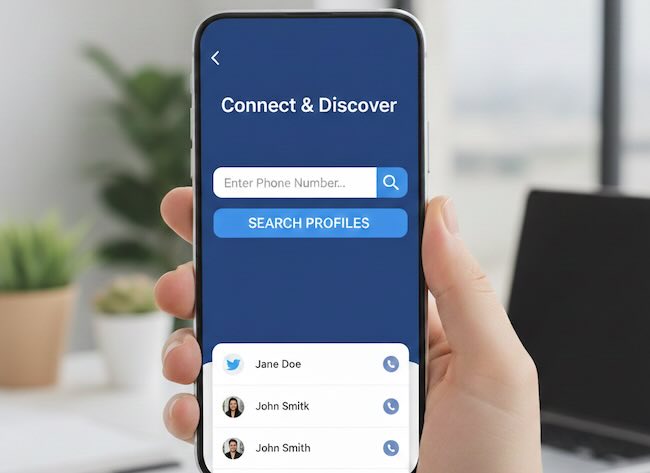
Phone numbers feel like perfect identifiers. They are unique, persistent, and tied to real-world devices. For years, many people believed that typing a phone number into a social network search bar would instantly reveal a profile.
Today, that assumption is mostly wrong.
Major platforms have significantly reduced public phone-based search. Privacy regulations, abuse prevention, and platform misuse forced changes. As a result, searching social profiles by phone number is no longer straightforward, and in many cases, it does not work at all.
This guide explains why phone-based identity discovery rarely delivers what people expect, where traces can still appear, what open-source intelligence can and cannot do, and how to protect your own exposure.
The goal is not to promise shortcuts. It is to clarify realities, boundaries, and legitimate investigative use.
Platform Deep Dive: How Messaging Giants Shield (and Sync) Identities in 2026
The “discovery” of a profile via phone number has evolved from a simple search query into a complex exchange of encrypted data. Each platform uses a different logic for “Contact Syncing,” and understanding these nuances is the key to modern OSINT (Open-Source Intelligence).
| App | Identity & Sync | Searchability & Privacy |
|---|---|---|
|
Primary ID: Phone Number Sync: PSI (Hashed Matching) |
Low (Direct search blocked) Kill switch: “My Contacts Except…” |
|
| Telegram |
Primary ID: Username Sync: Contact Book Upload |
Conditional (Settings-based) Kill switch: “Who can find me” (Nobody) |
| iMessage |
Primary ID: Apple ID / Phone Sync: Contact Key Verification |
Zero (Mutual sync only) Kill switch: Name & Photo Sharing Toggle |
| Snapchat |
Primary ID: Username Sync: “Quick Add” Algorithm |
Moderate (Sync suggest) Kill switch: “Show me in Quick Add” |
| Messenger |
Primary ID: Facebook ID Sync: Graph-based matching |
Zero (Decoupled 2023) Kill switch: Profile Privacy Settings |
|
Primary ID: WeChat ID Sync: Region-Locked Sync |
Low (Permissions required) Kill switch: “Find me by Mobile” Toggle |
1. WhatsApp: The Hashed Perimeter
WhatsApp remains the most “phone-centric” app, but it now uses Private Set Intersection (PSI). When you sync your contacts, WhatsApp doesn’t “see” your list; it compares cryptographic hashes of your numbers against its database.
WhatsApp documents this approach in its security architecture, explaining how contact discovery relies on privacy-preserving cryptographic techniques rather than open search. See WhatsApp’s official overview of its encryption and contact discovery model.
The OSINT Reality: You cannot “search” a number. However, the wa.me/[number] URL trick still allows you to see if a number is active, though profile pictures and “Last Seen” data are increasingly hidden from non-contacts by default.
2. Telegram: The Privacy Pioneer
Telegram has moved furthest away from phone numbers. It is the only major app that allows a “Nobody” setting for phone discovery.
Telegram publicly documents these discovery controls in its privacy and security guidelines, including how phone visibility and discovery permissions work.
The 2026 Factor: Even if you have a target’s phone number in your physical contact book, if they have set “Who can find me by my number” to “My Contacts” (and you aren’t one of them), their profile remains invisible to you. This “mutual-only” discovery has effectively killed reverse-lookup bots on the platform.
3. iMessage: The “Contact Key Verification” Era
Apple’s 2025 security push introduced Contact Key Verification (CKV). iMessage discovery is no longer just about having a number; it’s about a verified chain of trust.
Discovery Gate: You cannot find an iMessage profile through a public directory. The platform only shares the user’s “Name and Photo” once a conversation is initiated and both parties have the other in their address book.
4. Snapchat: The “Quick Add” Loophole
Snapchat remains the “leakiest” platform for phone-based discovery due to its Quick Add feature.
How it works: If you upload a contact list, Snapchat’s algorithm suggests those users immediately. Because Snapchat prioritizes “finding friends,” it often reveals usernames and Bitmojis associated with numbers more readily than the stricter Meta-owned platforms.
5. WeChat: The Regional Silo
WeChat (and its mainland counterpart Weixin) has strict siloed discovery.
The Constraint: Unless a user has explicitly enabled “Find me by Mobile Number” in their deep privacy settings, a phone sync will return no results. Furthermore, the platform often requires a “Security Verification” from a mutual friend to even view a profile found via a number.
Why People Believe Phone Number Search Is Easy
The belief did not come from nowhere. Years ago, some platforms openly allowed phone number search. Typing a number into Facebook or messaging apps could surface a matching profile. This capability was quickly abused for stalking, scraping, and spam.
As privacy concerns grew, platforms shut these doors.
This shift is part of a broader pattern in how platforms limit public discovery. We analyze these visibility changes and their impact on investigations in Why You Cannot Find Some Profiles Online.
However, three things kept the myth alive:
- Contact syncing inside mobile apps
- Stories of investigators using phone numbers successfully
- Marketing claims from questionable lookup services
Each contains a kernel of truth, but none reflect how the modern ecosystem actually works.
The “Sync” Method: How Social Apps Really Use Phone Contacts
Most social and messaging apps allow users to upload their phone contacts. The app hashes those numbers and compares them to accounts in its database. If matches exist, the app may recommend people you know.
What contact syncing actually does
- It matches uploaded contacts against internal records
- It does not expose search functionality publicly
- It is controlled by platform privacy settings
- It is invisible to outside users
This means that contact syncing is not a public search tool. It only operates inside a user’s own account environment, governed by the platform.
Why this leads to misunderstanding
When someone sees an app suggest a contact, they often assume the reverse is possible. In most cases, it is not. Platforms deliberately block reverse lookups to prevent abuse.
The sync method explains how phone numbers are used, but it does not provide a public search path.
Where Phone Numbers Still Leak Publicly
Despite platform protections, phone numbers continue to surface across the web.
Business and professional listings
Company websites, directories, resumes, and portfolios often publish phone numbers. These pages may link directly to social profiles or contain names that pivot into social search.
Marketplaces and classifieds
Listings for goods and services frequently display phone contacts. Sellers often reuse numbers across multiple platforms.
Forums and community posts
Some communities still allow phone numbers in signatures, posts, or profiles. Older forum archives are particularly rich in this data.
Data aggregation sites
Public people directories and business databases scrape phone numbers from many sources. While their accuracy varies, they can expose where a number has appeared publicly.
Leaked documents and reports
Conference brochures, event programs, and organizational PDFs sometimes include phone numbers that remain indexed long after publication.
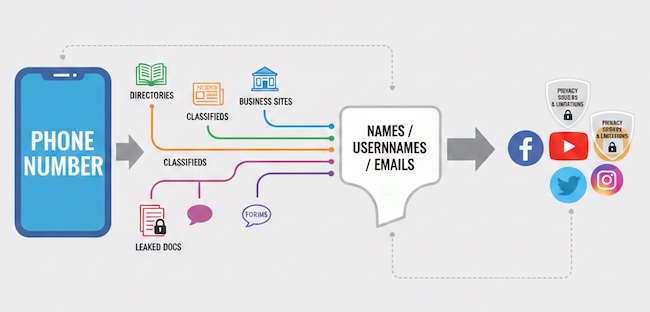
These exposures do not usually lead directly to a social profile. They lead to names, businesses, and websites that can then be searched more effectively.
Phone numbers are only one small part of public exposure. Understanding how identifiers spread across sites, documents, and platforms provides the context needed to interpret these traces. Our guide Digital Footprint: How Much of You Is Public? explores how online identity expands beyond social networks.
What OSINT Can and Cannot Do with Phone Numbers
What OSINT can do
- Find public pages where a number appears
- Associate a number with a business or person
- Identify geographic or industry context
- Discover usernames and emails linked indirectly
What OSINT cannot do
- Bypass platform privacy controls
- Reveal hidden account associations
- Access private databases
- Guarantee a social profile match
Most successful phone-based research does not produce a direct profile. It produces pivot points that enable structured user search.
Common Scams and Fake Tools
High demand creates fertile ground for deception.
Many websites claim to instantly reveal social profiles from a phone number. Typical red flags include:
- Guaranteed results
- Paywalls before previews
- Lists of logos implying platform access
- Promises of private data retrieval
These services often rely on scraped public directories, outdated databases, or outright fabrication. Some exist primarily to collect numbers or push subscriptions.
Legitimate research rarely looks instant or dramatic.
Legitimate Investigation Use Cases
Business verification
A phone number listed on a website can be traced to business pages, directories, and then to official social profiles for confirmation.
Fraud prevention
Numbers reused across scam listings may surface in forums, complaint boards, and archived posts that reveal patterns.
Journalistic research
Public documents containing numbers can lead to organizational charts, speaker lists, and social identities tied to public roles.
Brand protection
Unauthorized sellers using a company’s contact number may expose connected social accounts.
Correlation vs Certainty
A phone number appearing alongside a name on a site suggests a link. It does not confirm ownership of a social profile.
Certainty emerges when:
- The same number appears on multiple authoritative sites
- It aligns with business registrations or publications
- Names connect consistently across platforms
- Social profiles link back to the same contact points
Single appearances should be treated as leads, not conclusions.
Legal and Privacy Exposure
Phone numbers are protected personal data in most jurisdictions.
Collecting, storing, or processing them may trigger legal obligations. Even when a number is publicly visible, how it is used matters.
Under European privacy law, phone numbers are considered personal data because they can directly or indirectly identify individuals, which affects how investigators and researchers must handle them responsibly (see European Data Protection Board guidance on personal data).
Responsible research requires:
- Legitimate purpose
- Minimal data retention
- Respect for platform terms
- Awareness of regional privacy laws
Attempting to bypass safeguards or access non-public systems crosses ethical and often legal boundaries.
Defensive Privacy Steps
Understanding phone-based discovery helps reduce personal exposure.
- Review privacy settings on social platforms
- Limit where your number is published
- Use separate numbers for public listings
- Remove numbers from old forums and profiles
- Audit business directories regularly
Most phone-based traces persist because they were once published and never removed.
From Phone Number to Identity Mapping
Phone-based research rarely ends with the number itself.
It usually produces names, businesses, emails, or websites. These elements become stronger anchors for identity discovery.
If a phone number surfaces a name or username, the next step is structured social media user search. From there, social profiles, communities, and networks can be mapped with far greater reliability.
Conclusion
Searching social profiles by phone number is far more limited than most people expect.
Direct lookups are largely closed. Public exposures are fragmented. Results require interpretation, not automation.
Understanding what works, what does not, and where traces actually appear protects against false promises and supports legitimate, ethical research.
Phone numbers are powerful signals, but only when treated as starting points, not shortcuts.
FAQ: Finding Social Profiles by Phone Number
Can you search Facebook or Instagram by phone number?
Not publicly. Major platforms no longer allow direct phone-based profile searches.
Do contact sync features allow reverse lookups?
No. They only operate inside user accounts and do not expose public search tools.
Where do phone numbers most often appear online?
On business websites, directories, classifieds, older forums, and public documents.
Are paid phone lookup tools reliable?
Many rely on scraped public data or outdated records. Guaranteed social matches are a warning sign.
What is the safest way to use a phone number in research?
To find public references that lead to names or organizations, then pivot into structured identity search.
Is it legal to search phone numbers?
Searching public pages is generally lawful, but phone numbers are protected data and must be handled responsibly.
How can people protect themselves?
By limiting public exposure, reviewing privacy settings, and removing numbers from unnecessary public pages.
How does phone research support user search tools?
It produces names or usernames that can then be mapped across platforms using dedicated user search workflows.