For marketers and startup founders, a brand is not only a logo or a product. It is digital territory. A structured process to check username availability for brand use across platforms helps define and defend that territory. Every social profile, community platform, forum and content network represents a plot of land where your brand can either grow or be exploited by someone else. Before campaigns, before growth hacks, even before your first big press mention, there is a fundamental step that often gets skipped: the brand handle audit.
This process is not about finding people. It is not about curiosity searches. It is about competitive intelligence, brand protection and long term visibility. A proper audit helps you check username availability for brand use, understand where your name already exists and define how your identity will look across the social web.
In this guide, we will walk through why consistent handles matter, how social usernames impact SEO, how to run a structured brand handle audit and what to do if your ideal username is already taken.
Your username is not just a label. It is a doorway. Whoever controls it controls the first impression.
1. The “Squatter” Risk: Why You Need to Own Your Handle Everywhere
Digital land gets taken fast
Every major social platform has millions of dormant accounts. Some were registered years ago by individuals experimenting with ideas. Others were created by marketers who anticipated trends. Some exist only to resell usernames later. Whatever the motivation, the reality is the same: once a handle is taken, it is rarely easy to recover.
For startups, this creates a hidden vulnerability. You may secure your company name as a domain, launch a product and start marketing, only to discover that your brand handle is already in use on Instagram, TikTok or YouTube. Even worse, it may be used by someone posting unrelated or low quality content.
This is the squatter risk. It is not theoretical. Brands regularly face impersonation, handle resale attempts and confusion that costs real money and trust, a risk acknowledged directly by major platforms.
Why consistent handles matter
Consistency across platforms builds cognitive recognition. When a user sees @YourBrand on LinkedIn, then searches the same name on X, Instagram or YouTube, the expectation is to find you. If they instead find @YourBrandHQ, @RealYourBrand or @YourBrand_Official, friction is introduced.
Each variation weakens recall and increases the chance that a competitor, reseller or fake account captures attention that should belong to you.
- Consistent handles make your brand easier to remember.
- They reduce the risk of impersonation.
- They simplify campaign tagging and influencer mentions.
- They strengthen brand trust signals.
A brand handle audit is the process of identifying where you already control territory and where you are exposed.
2. SEO Value: How Social Profiles Support Your Brand Search Presence
Social profiles often outrank websites
Search engines love authority domains. Platforms like Facebook, LinkedIn, Instagram, X and YouTube have massive trust and link equity. As a result, branded social profiles frequently rank on the first page for brand name searches, especially for early stage startups.
That means your usernames are not only social assets. They are SEO assets.
If you control your brand handle on major networks, you effectively occupy more real estate in search results. Your site, your LinkedIn page, your X profile, your YouTube channel and possibly your Instagram profile can all appear together. This pushes competitors, resellers and review sites further down the page.
SEO benefits of username ownership
- Increased branded SERP coverage.
- Stronger brand entity signals.
- Reduced visibility for third party pages.
- Higher trust for users researching your company.
From a marketing perspective, this matters because the branded search stage is where users validate credibility. Investors, journalists, partners and customers all search your brand before engaging. A fragmented or polluted presence introduces doubt.
When you check username availability for brand use early, you are not only preparing for social growth. You are shaping how your brand will appear in search engines for years.
3. Consistency: Why Matching Handles Beat Clever Variations
The cost of small differences
At first glance, @YourBrand and @YourBrandOfficial may seem interchangeable. In practice, they are not. Every additional word, underscore or abbreviation adds friction.
Marketing teams often underestimate how often users manually type handles, search within apps or try to remember a brand without clicking a link. In those moments, consistency wins.
When your Instagram handle differs from your TikTok handle, which differs again from your YouTube channel, you create micro failures. Users hesitate. They question authenticity. Some abandon the search entirely.
Brand handle coherence
A strong brand handle audit evaluates coherence, not only availability. It asks:
- Do we own the exact brand name on priority platforms?
- Are there active accounts using similar names?
- Are competitors or affiliates occupying confusing variants?
- Are we forced into a naming structure that weakens recall?
For founders, this is part of brand architecture. The same rigor applied to naming a product should be applied to naming your social identity.
4. The Audit Process: How to Check Username Availability for Brand Use
Step one: define your territory list
Before searching, define where you care about presence. For most marketing and startup teams, this typically includes:
- X
- TikTok
- YouTube
- Medium
- GitHub or Product Hunt for tech brands
This list should reflect both marketing channels and potential community spaces.
Step two: manual platform checks
The simplest method is to search directly inside each platform. This reveals whether the exact handle is taken and often shows similarly named accounts.
However, this is time consuming and error prone. Interfaces change. Some platforms hide dormant accounts. Others display partial matches before exact ones.
Manual checks are useful for validation, but not ideal for discovery.
Step three: using Google with the site: operator
Google can act as a broad scanner. By combining your desired handle with platform specific queries, you can quickly uncover existing profiles, using structured search operators for OSINT-style brand discovery.
Examples:
- site:instagram.com “yourbrand”
- site:tiktok.com “@yourbrand”
- site:x.com “yourbrand”
- site:linkedin.com/company “yourbrand”
This approach often surfaces profiles that do not appear in app searches, including inactive or region restricted accounts.
It is also useful for identifying third party usage, fan pages and potential impersonators.
Step four: using Social Searcher for brand handle audit
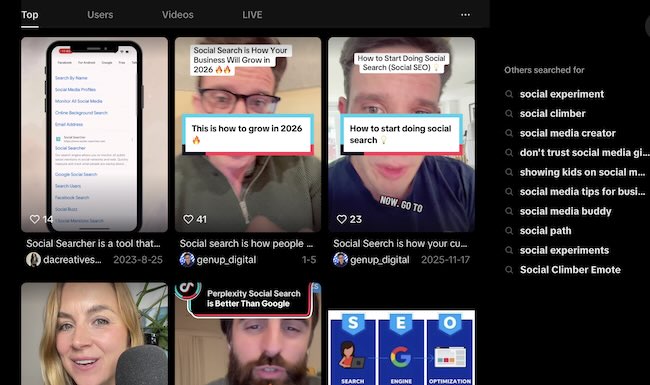
For marketers who want a faster and more structured approach, tools like Social Searcher can centralize this process.
Instead of jumping between networks, you can use a single interface to search your brand name or desired username across multiple platforms. This supports competitive and brand OSINT workflows by revealing where a name is already in use, how active those accounts are and in what context your brand string appears.
From a brand handle audit perspective, this offers several advantages:
- Faster discovery of existing profiles.
- Broader coverage across social networks.
- Contextual insight into how a name is being used.
- Early detection of impersonation risks.
Rather than asking only “is it taken?”, you begin to ask “who is using it, where and for what purpose?”. That shift is important for brand strategy.
Step five: document and prioritize
Audit results should be documented. Create a simple matrix listing platforms, exact handle status, similar handles and risk level.
- Owned and active.
- Available and unclaimed.
- Taken but inactive.
- Taken and active.
- Taken by unrelated brand.
This transforms scattered checks into a strategic overview.
5. What to Do If Your Handle Is Taken
Assess before reacting
Not every taken handle is a crisis. The response depends on who owns it, how active it is and whether it creates confusion.
Key evaluation questions:
- Is the account active or abandoned?
- Is it in the same industry?
- Does it use your logo, branding or messaging?
- Could a user mistake it for you?
If the account is inactive and clearly unrelated, a clean variation may be acceptable. If it is active and confusing, escalation may be required.
Smart use of prefixes and suffixes
When the exact brand name is unavailable, choose variations that preserve clarity and recall. Avoid clutter.
Common and effective modifiers include:
- getyourbrand
- yourbrandhq
- yourbrandapp
- yourbrandofficial
The goal is to create a consistent system across all platforms. Do not improvise per network. Decide once and apply everywhere.
For example, if @YourBrand is unavailable everywhere, but @YourBrandHQ is free on all major platforms, that uniformity may be stronger than a mix of random options.
Brand protection workflows
For funded startups and growing brands, handle ownership becomes part of brand protection.
This can include:
- Reserving variations even if unused.
- Applying for trademark based username claims.
- Monitoring new registrations of similar handles.
- Setting alerts for impersonation.
This also involves active processes for identifying and responding to impersonation risks before they damage trust.
Tools like Social Searcher can support this ongoing monitoring by surfacing new mentions and accounts using your brand string. This moves the brand handle audit from a one time task into a continuous process.
When to pursue recovery
Recovery attempts should be strategic. Platforms generally require evidence of trademark ownership and clear risk of confusion. Before initiating a claim:
- Secure your trademark where possible, since trademark ownership is the foundation of most platform username dispute processes.
- Document your existing presence and usage.
- Capture examples of confusion or impersonation.
Even if recovery is unsuccessful, the documentation strengthens future actions.
Turning a Handle Audit into a Marketing Asset
A brand handle audit is often framed as defensive. In reality, it is offensive marketing infrastructure.
By securing consistent usernames, you enable:
- Clean influencer mentions.
- Unified campaign hashtags.
- Stronger branded search performance.
- Easier community building.
For founders, it also reduces cognitive load. Every pitch, interview, deck and product page can reference the same social identity.
In a landscape where trust is fragile and attention is fragmented, small details like username consistency accumulate into competitive advantage.
Brands that own their digital territory move faster. They spend less time correcting confusion and more time building momentum.
FAQ: Brand Handle Audits and Username Availability
What is a brand handle audit?
A brand handle audit is the structured process of checking where your brand name or desired username exists across social networks, forums and platforms. It evaluates availability, conflicts, impersonation risk and consistency opportunities.
Why should startups check username availability early?
Because usernames are rarely released once taken. Early checks allow startups to secure digital territory before public launches, campaigns and press exposure. This reduces squatter risk and long term brand confusion.
Is this only about social media?
No. While social platforms are primary, a true audit also considers communities, content platforms and developer spaces. Anywhere users can create public identities is relevant.
How does a brand handle audit support SEO?
Owned social profiles often rank for brand searches. By controlling these assets, brands increase their presence on the first page of search results and push third party pages lower.
Can Social Searcher help with brand handle audits?
Yes. Social Searcher allows marketers to scan multiple networks for brand names and usernames, supporting discovery, monitoring and competitive OSINT workflows.
What if my brand name is completely unavailable?
In that case, select a clear and consistent modifier, secure it across all key platforms and document your naming convention. Over time, consistency matters more than perfection.
How often should a brand handle audit be repeated?
At minimum, review quarterly. High growth brands should monitor continuously, as new platforms emerge and impersonation attempts increase.
Is it worth claiming platforms we do not actively use?
Yes. Reserving usernames prevents misuse and keeps future options open. Even dormant profiles protect brand equity.
Does trademark registration guarantee handle recovery?
No. It strengthens your position but does not guarantee success. Platforms make independent decisions based on their policies.
Who should own this process in a company?
Typically, it sits between marketing, brand and legal. In early stage startups, founders or heads of marketing usually lead it.
What is the biggest mistake brands make with usernames?
Waiting too long. By the time a brand gains visibility, its ideal handles are often already gone.