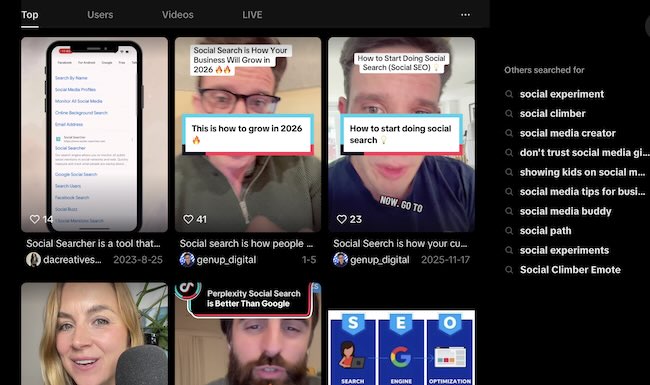
TikTok has become one of the most powerful discovery engines for finding people, creators, and lived experiences online.
Millions of users now open TikTok not to browse, but to search. They look for people, experiences, places, tutorials, and communities. For a growing share of Gen Z and Gen Alpha, TikTok is often the first stop when trying to understand a topic or find someone connected to it.
This shift has been documented in independent research exploring how younger audiences increasingly rely on TikTok and similar platforms for discovery rather than traditional search engines (New York Times analysis of TikTok as a search alternative).
To use TikTok effectively, it is no longer enough to follow trends. You need to understand how TikTok’s internal search system works, what it indexes, and how it surfaces both content and creators.
This guide explores how TikTok search actually functions, what discovery options exist, and how identities emerge inside the platform’s ecosystem.
Why TikTok has become a primary discovery platform
Traditional search engines were designed around documents. TikTok is designed around signals.
Every video uploaded to TikTok carries multiple layers of information. Not just captions, but spoken language, on-screen text, visual objects, sound reuse, watch behavior, and interaction history.
Instead of ranking pages, TikTok organizes attention.
Its systems continuously interpret:
- what appears in frames
- what is said aloud
- what text overlays contain
- what sounds connect videos
- how users watch, save, share, and comment
These layered signals reflect a broader shift toward multimodal visibility systems shaping modern social discovery, explored further in Content Signals 2.0: How to Master Multimodal Search & Social Visibility.
This makes TikTok search fundamentally different from web search. A query does not retrieve documents. It activates clusters of videos and creators connected by meaning, behavior, and media patterns.
| Search Feature | Traditional Search (Google) | TikTok Discovery |
|---|---|---|
| Primary Index | Text-based documents and HTML metadata. | Multimodal signals (Audio, OCR, Visuals). |
| Discovery Logic | Keyword matching and domain authority. | Behavioral clusters and community signals. |
| Result Priority | Accuracy and informational utility (“Tell me”). | Authenticity and lived experience (“Show me”). |
| Ranking Signal | Backlinks and technical SEO. | Watch time, saves, and audio reuse. |
| User Relationship | Transactional: Query → Answer. | Relational: Experience → Identity. |
What TikTok search actually indexes
TikTok’s discovery systems are multimodal. They do not rely on a single input type.
Captions and long descriptions
Captions on TikTok have evolved from short phrases into full context blocks. They are indexed not only for keywords, but for topical relevance and semantic intent.
Longer descriptions help TikTok understand what a video represents, not just what it contains. They support discovery around professions, routines, locations, tutorials, and narratives.
On-screen text
TikTok reads what appears inside the video frame.
Text overlays such as “Day one at my new job” or “Living in Berlin as a student” are interpreted through optical character recognition and connected to search queries.
In practice, this means a video can surface even when the caption does not mention the same phrase.
Spoken audio
Speech is transcribed and indexed.
Spoken phrases, questions, and explanations often influence search results more than hashtags. TikTok increasingly behaves like a voice-first search environment where what is said matters as much as what is written.
Sounds and music
Every sound on TikTok forms a searchable ecosystem.
Sounds connect videos across time, topics, and communities. Searching a sound does not retrieve one post. It surfaces a network of creators linked through audio reuse.
Behavioral signals
How users interact with videos influences discovery visibility.
- watch time
- rewatches
- saves
- profile visits
- comment depth
These behaviors shape which videos and creators appear when similar searches are made.
Engagement-based ranking models that prioritize watch time and interaction depth are widely discussed within recommendation system research and platform transparency reporting (TikTok transparency explanation of recommendation systems).
How people appear in TikTok search
TikTok rarely surfaces people simply because of their usernames.
It surfaces creators because of the roles they occupy inside content ecosystems.
Common discovery patterns include:
- people associated with specific routines
- profession-based creators
- local environment contributors
- trend-originators and sound participants
- narrative-driven personalities
This is why searching “morning gym routine” or “life as a product designer” often reveals people before brands. TikTok search privileges lived context.
Using TikTok search to discover people
Most TikTok users search too narrowly. They enter one word and scroll.
Effective TikTok discovery starts by searching experiences rather than identities.
Context-based queries
TikTok surfaces creators strongly when searches describe situations.
- working night shift hospital
- first year medical student life
- opening a coffee shop
- living alone in Tokyo
- day in the life of a UX designer
These searches activate clusters of creators whose content repeatedly reflects similar experiences.
Routine and lifestyle discovery
Routines are one of TikTok’s strongest identity signals.
Searching around fitness, study habits, travel routines, parenting, or workdays often surfaces the same creators consistently. Over time, TikTok associates individuals with certain lived patterns.
Location-driven discovery
TikTok search increasingly surfaces location-based content.
City names, neighborhood references, and local business mentions frequently connect to creators who repeatedly film in the same environments.
This makes TikTok one of the most active platforms for discovering local identities.
Sounds, hashtags, and suggestion systems
Sound pages as discovery hubs
Every sound on TikTok has its own ecosystem.
Sound pages reveal:
- early adopters
- repeat contributors
- trend variations
- community styles
Creators who consistently appear across sound clusters often form the core identity layer of a trend.
Hashtags as topic anchors
Hashtags on TikTok are not traditional SEO tags.
They act as topical anchors that help group content ecosystems. Smaller, specific hashtags often surface tighter identity clusters than high-volume tags.
Related searches and suggestion prompts
TikTok’s interface now actively suggests related searches inside result pages and comment sections.
These prompts reveal how TikTok connects topics, creators, and communities. They often surface identities users would not find through direct keyword input.
TikTok filters and search refinement
TikTok search includes internal refinement tools that many users overlook.
Watched videos
This filter surfaces content previously seen. It is one of TikTok’s most powerful rediscovery features.
Latest and top content
Latest emphasizes emerging creators and trends. Top emphasizes stabilized identities and established topic clusters.
Creator versus video views
Switching between creators and videos changes discovery behavior. Creator-focused views often surface recurring contributors rather than one-off viral clips.
When TikTok search does not surface profiles
There are structural reasons some identities remain invisible.
- heavy personalization limits reach
- faceless or aggregator accounts dilute authorship
- frequent renaming disrupts continuity
- micro-communities remain behaviorally isolated
This is why the same query can surface entirely different people on different accounts.
Many of these visibility limitations mirror broader discoverability barriers across the web, discussed in detail in Why You Cannot Find Some Profiles Online.
TikTok discovery is shaped by who you are, what you watch, and how you interact.
From TikTok discovery to identity visibility
TikTok surfaces people through content ecosystems. It does not resolve identity beyond the platform.
Once a creator becomes visible, broader identity work often happens outside TikTok.
Creators frequently maintain parallel presences across:
- YouTube
- X
- personal websites
Connecting these presences allows discovery to evolve into verification and context building.
This is where structured user search becomes essential.
Using a dedicated cross-platform user search workflow helps map where a surfaced TikTok identity appears elsewhere, how long it has existed, and what broader digital footprint it maintains.
Learn more about cross-platform identity expansion here: User Search and People Discovery
Why TikTok literacy now matters for people search
Modern identity discovery increasingly begins inside platforms, not browsers.
TikTok shapes which identities become visible, which communities form, and which creators surface long before websites exist.
Understanding TikTok search is no longer optional. It is foundational.
It explains why some people are discoverable everywhere, while others remain invisible despite large audiences.
TikTok does not rank pages. It constructs identity layers.
FAQ: TikTok search and discovery
Can you search TikTok for people directly?
Yes. TikTok search surfaces both videos and creator profiles. People often appear through contextual searches rather than direct username queries.
Does TikTok read text inside videos?
Yes. On-screen text is interpreted and indexed, contributing to how videos and creators surface in search.
Are sounds searchable on TikTok?
Yes. Sounds form discovery hubs that group creators and content across trends and communities.
Why do TikTok results differ between users?
Search and discovery are influenced by personalization signals such as watch behavior, interaction history, and community proximity.
Is TikTok better than Google for discovering people?
For emerging creators, local communities, and experiential identities, TikTok often surfaces people long before they appear in traditional search engines.
How does TikTok discovery connect to people search tools?
TikTok surfaces identities through content. Cross-platform user search reveals where those identities exist beyond TikTok.
What is the biggest mistake people make using TikTok search?
Searching only names. TikTok surfaces people most effectively through situations, routines, topics, and lived context.