Social platforms no longer organize visibility through pages. They organize it through signals.
Whether someone is searching for a person, exploring a topic, or following a trend, discovery is shaped by how platforms interpret behavior, media, and relationships. What surfaces is not a list of profiles. It is an evolving identity layer built from patterns.
Understanding these patterns is essential for anyone who wants to be discoverable, verifiable, or visible across modern social ecosystems.
Why social platforms surface people differently than the web
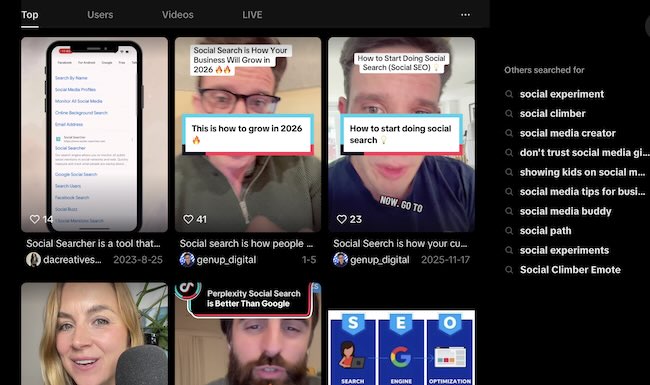
Web search engines were designed to rank documents. Social platforms were designed to interpret activity. This aligns with the massive shift in search behavior seen across Gen Z and Alpha, who increasingly treat social feeds as their primary discovery engines.
Instead of links and pages, they analyze:
- how content looks
- what is said
- how users respond
- who interacts with whom
- which themes repeat
From these inputs, platforms infer identity roles. They decide which creators belong to which topics, communities, and narrative spaces.
This is why visibility on social platforms rarely comes from a single post. It emerges from repeated signals.
The five core signal layers that shape discovery
Across TikTok, Instagram, YouTube, and emerging platforms, most discovery systems evaluate the same fundamental signal categories.
1. Textual signals
Text remains a foundational layer, but it is no longer the dominant one.
Platforms interpret:
- captions and descriptions
- on-screen text inside videos
- profile bios
- hashtags and labels
- comment language
Textual signals define topical relevance. They tell systems what a piece of content is about and how it should be grouped.
Consistency matters. Repeated language patterns strengthen association between creators and subjects. Fragmented text weakens identity coherence.
This applies to your handles as well; ensuring uniformity is a key part of checking username availability across social networks to secure your brand entity.
2. Visual signals
Modern platforms actively interpret frames. (To understand how these detection systems work in reverse, explore our guide on Visual OSINT and finding people by photo.)
They evaluate:
- recurring environments
- recognizable objects
- distinctive filming styles
- location characteristics
- visual continuity across posts
Visual signals often anchor creators to contexts. A consistent workspace, gym, city environment, or studio setup becomes an identity cue.
Over time, platforms associate these visual patterns with specific themes and audiences.
3. Auditory signals
Spoken language and sound selection form another discovery layer.
Platforms process:
- speech transcripts
- recurring phrases
- voice consistency
- sound reuse
- audio trend participation
Audio signals connect creators to narrative styles and communities. Regular participation in certain sound ecosystems strengthens topical association.
Spoken content increasingly drives search and discovery outcomes.
4. Behavioral signals
Behavioral data shapes visibility more than any caption.
Platforms monitor:
- watch time and completion rates
- rewatches and saves
- comment depth
- profile visitation patterns
- sharing behavior
These behaviors indicate relevance. They tell systems whether content resonates, circulates, or fades.
Creators become discoverable not when they post, but when their content repeatedly holds attention.
5. Network signals
Social platforms are fundamentally relational.
They interpret:
- who comments on whom
- who appears together
- which creators respond to each other
- which audiences overlap
- how communities form around topics
These connections construct social proximity maps. Identity visibility often emerges from where someone sits inside these networks.
It is the cumulative effect of these interactions that defines how much of your digital footprint is public.
How signals combine into identity visibility
No single signal defines discoverability.
Platforms correlate layers.
A creator becomes visible when:
- their text signals align with their visuals
- their audio patterns repeat
- their audiences behave consistently
- their networks stabilize
This convergence allows systems to infer who someone is within the ecosystem.
Over time, these correlations determine which queries, topics, and communities surface a person.
Why repeated context matters more than virality
Viral moments create exposure. Signals create identity.
Platforms struggle to classify one-off posts. They learn from repetition.
Repeated contexts strengthen:
- topic associations
- audience clustering
- recommendation confidence
- search relevance
This is why some creators remain discoverable years after posting, while others disappear despite large single-post reach.
Platform-Specific Hacks That Have Emerged as Standard
While the core signals of text, audio, and behavior remain universal, the “Big Three” platforms have developed specialized indexing behaviors. The baseline for visibility is no longer just “posting content”—it is Multimodal Search Optimization (MSO).
The Deep Dive: Basics of the Visibility Boost
Before applying specific hacks, you must master Signal Alignment. In the current landscape, AI models analyze all content layers simultaneously. If your spoken audio mentions “luxury travel,” but your visual background is a cluttered home office and your caption is about “saving money,” the platform’s Confidence Score in your content drops. High visibility is granted to “clean” signals where the AI can easily categorize you as a specific Entity.
TikTok: The “Acoustic Index” Hack
TikTok’s search engine now prioritizes the first 3 seconds of spoken audio over captions or hashtags. This is part of their evolving recommendation system, which uses real-time transcription to “stamp” the video’s topical intent before it even finishes the first loop.
- The Hack: Speak your primary keyword clearly within the first sentence. This creates an “Acoustic Anchor” that tells the AI exactly which search bucket to place you in.
- Comment SEO: Don’t just “heart” comments. Respond with keyword-rich answers. TikTok indexes comment threads as part of the video’s Topic Cluster, increasing the long-tail search reach of the original post.
Instagram: The “Vibe Index” & Semantic Bios
Instagram has moved fully into “Vibe Indexing.” The AI categorizes accounts based on their Visual Signature—the consistent color palettes, lighting styles, and recurring objects in your Reels and Grid.
- The Hack: Maintain aesthetic consistency. If the AI can instantly recognize your “Visual Signature,” it will serve your content to “Lookalike Audiences” who engage with that specific aesthetic style.
- The 3-Hashtag Rule: The era of 30 hashtags is over. Using more than 3–5 highly specific hashtags is seen as “Signal Noise” and can dilute your reach. Instead, use that space for a descriptive, semantic caption that Google (which now indexes IG posts) can read.
YouTube: The “Satisfaction Score”
YouTube has pivoted away from “View Count” as a success metric, replacing it with a “Satisfaction Signal.” This measures whether a viewer stayed on the platform or performed a “Session Exit” after your video.
- The Hack: Use YouTube Shorts as a Laboratory. Test different hooks in a 60-second format. If a Short has a high “Re-watch Rate,” it’s your green light to produce a 20-minute deep dive on that exact topic. The algorithm will “bridge” that Shorts audience over to your long-form content.
The Golden Metric: Completion Rate over Reach
The algorithms have been recalibrated to ignore “Empty Reach” (users who swipe past after 2 seconds).
The Rule of Thumb: A video seen by 100 people to the very end is worth more to the algorithm than a video seen by 10,000 people for only 3 seconds.
High completion rates signal to the platform that your content is “Satisfying,” triggering a deeper second-wave distribution to users who aren’t even in your follower base.
Building a Unified Signal Ecosystem
The most successful creators don’t just win on one platform; they build a Unified Signal Ecosystem. When your “Acoustic Anchor” on TikTok matches your “Visual Signature” on Instagram, platforms begin to recognize your brand as a high-authority Entity rather than just another account.
This cross-platform continuity creates a compounding effect:
- Search Dominance: Google and Bing now prioritize social entities with consistent multimodal signals across multiple domains.
- Algorithmic Trust: When a user engages with your “Vibe” on Reels, YouTube is more likely to suggest your Shorts because it recognizes the underlying visual patterns.
- Brand Recall: Consistency in environments and spoken themes reduces the friction of discovery, turning a first-time viewer into a long-term follower.
This is where professional visibility management becomes essential. To dominate search, you must ensure your identity signals are firing correctly across the entire social web.
Check your brand’s cross-platform signal consistency here: Social Profile Search & Omnichannel Identity Discovery Tool
The Risk of “Signal Fragmentation”
The greatest threat to your visibility isn’t a “shadowban”—it is Signal Fragmentation. This happens when your content patterns become too erratic for AI to categorize.
Common visibility killers include:
- Context Clashing: Posting wildly different topics that confuse the “Topic Cluster” indexing.
- Aesthetic Shifting: Frequent changes in lighting, background, or editing styles that break your “Visual Signature.”
- Keyword Dilution: Using generic captions that fail to provide the semantic depth required for modern Social SEO.
Understanding these signals is no longer just a “hack”—it is the foundation of digital reputation management. High-visibility brands are those that provide the algorithm with a clear, repetitive, and satisfying map of who they are and what they offer.
Conclusion: From Scrolling to Searching
The transition from “Social Media” to “Discovery Engines” is complete. Users are no longer just scrolling for entertainment; they are searching for expertise, experiences, and identities they can trust.
To stay visible, your strategy must move beyond the “viral hit.” You must focus on building a Signal-First Brand—one that is transcribed, indexed, and recognized by AI across every frame and every second of audio.
You don’t find your audience. Your signals lead the audience to you.
FAQ: Optimizing for Social Discovery
How often should I update my “Signal Layers”?
Consistency is key, but minor evolutions are healthy. Aim for a stable “Visual Signature” for at least 3-6 months to allow the AI to solidify your entity categorization.
Do captions still matter if the AI transcribes my audio?
Absolutely. Captions provide the Textual Reinforcement that confirms the AI’s transcription. They act as a secondary safety net for search indexing.
Can I “reset” my signals if I pivot my niche?
Yes, but it takes time. You must consistently post new “Acoustic Anchors” and “Visual Cues” for several weeks before the platform re-clusters your account into a new niche.
How does Social SEO affect my website’s Google ranking?
Google increasingly indexes high-authority social content. Strong signals on TikTok and YouTube often result in your social posts appearing in Google Search “Video Perspectives” and “Short Videos” carousels.