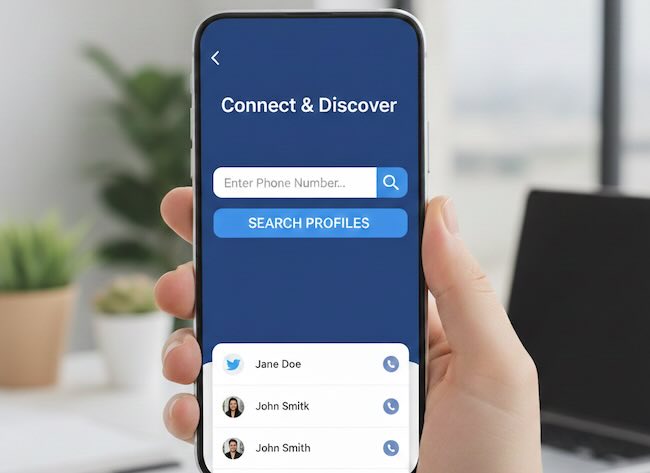
Almost everyone has experienced it. You type a name into Google, Facebook, LinkedIn, or Instagram and nothing useful comes up. No profile. No trace. It can feel confusing, frustrating, or even suspicious. If you can’t find a person on social media or you can’t find someone online at all, the reason is usually far more ordinary than people expect.
This article breaks down the most common reasons behind missing profiles search issues and expands on the concepts covered in our complete guide to searching for people online. It is written as a practical troubleshooting guide and FAQ style resource to support deeper user search research. Instead of assuming someone has disappeared, you will learn how social platforms, privacy tools, and technical limitations shape what you can and cannot see.
1. Privacy Settings Hide More Than You Think
One of the most common reasons you can’t find a person on social media is intentional privacy configuration. Major platforms actively encourage users to control how visible they are in search.
Unlisted Profiles on Facebook and LinkedIn
Facebook allows users to limit who can search for them using email, phone number, or even name-based queries. A profile can still exist and be fully active while remaining invisible to public search.
These options are part of Facebook’s official privacy and discoverability controls, which determine how profiles appear in search.
LinkedIn offers similar functionality. Users can hide their profile from public search engines or appear only to logged-in connections. In some cases, even internal LinkedIn search will not display a profile unless there is a shared connection.
Private Accounts on Instagram and TikTok
On platforms like Instagram or TikTok, private accounts do not appear in many external search results. Even within the platform, search visibility can be restricted to followers only.
Invisible does not mean inactive. It often means intentionally restricted.
2. The Shadowban Effect and Blocked Crawlers
The term shadowban is often misunderstood. It does not always mean punishment. In many cases, it simply refers to reduced discoverability.
How Platforms Limit Search Exposure
Social networks constantly adjust how profiles appear in search results. New accounts, low activity accounts, or accounts that trigger automated moderation systems may be temporarily excluded from search suggestions.
Additionally, some platforms block external crawlers entirely. This means search engines like Google cannot index profiles, even if the account is public.
Why You Won’t See These Profiles in Google
If a platform blocks indexing, the profile exists only inside that ecosystem. Searching outside it will return nothing, leading people to assume the account does not exist.
3. Indexing Lag for New Accounts
If you can’t find someone online who recently joined a platform, timing may be the issue.
New Profiles Take Time to Appear
Search indexing is not instant. New accounts often require days or weeks before they become visible in internal or external search systems. This delay is common across social networks.
Google itself confirms that indexing delays are normal, especially for new or low-activity pages.
Activity matters. Profiles with no posts, no followers, and no interactions may be deprioritized or excluded entirely until they show signs of real use.
4. Deleted or Deactivated Accounts
Sometimes the simplest explanation is the correct one. The profile may be gone.
Temporary Deactivation vs Permanent Deletion
Many platforms allow users to deactivate accounts temporarily. During this time, the profile disappears from search completely. If the account is permanently deleted, no search method will recover it.
Old links may still exist, but they will lead to error pages or empty results.
5. Region Locks and Geographic Restrictions
Another overlooked reason for missing profiles search issues is regional visibility.
Location-Based Search Results
Some platforms adjust search results based on the viewer’s country. A profile visible in one region may be hidden or deprioritized in another.
This is especially common on platforms with strong regional policies or compliance requirements.
6. Non-Public or Niche Platforms
Not everyone uses mainstream social media.
Communities Outside Major Networks
Many professionals and hobbyists operate on niche platforms, forums, or invite-only communities. These profiles are often invisible to search engines and general users.
In these cases, you can’t find someone online because you are simply looking in the wrong place.
7. How OSINT Approaches Invisible Profiles
Open Source Intelligence techniques focus on correlation rather than single-profile discovery.
Pattern-Based Searching
Instead of relying on one platform, OSINT researchers analyze usernames, profile images, writing style, and behavioral patterns across multiple sources.
Even when a profile is hidden, traces often remain in comments, mentions, or archived content.
Manual techniques such as advanced Google search operators are often used to uncover indirect mentions that standard searches miss.
Absence of evidence is not evidence of absence.
8. Common Name and Spelling Issues
If you are searching for someone with a common name, visibility becomes even harder.
Why Names Like John Smith Are Hard to Find
Search algorithms prioritize relevance and engagement. A common name without location, workplace, or other identifiers gets buried under thousands of similar profiles.
Inconsistent or Misspelled Names
Many users intentionally alter spelling, use nicknames, or switch name order. Accents, transliteration differences, and initials can further complicate discovery.
In practice, this often extends to usernames as well, which is why analyzing username variations across platforms can reveal profiles that name-based searches miss.
- Different alphabets or languages
- Use of middle names or initials
- Maiden or previous surnames
9. What to Do Next When Search Fails
There is a point where continuing the same search becomes unproductive.
Change Strategy Instead of Repeating Queries
If you can’t find a person on social media after multiple attempts, try alternative data points. Look for shared connections, professional mentions, or content interactions.
When direct searches fail, applying a reverse real-name search strategy often produces better results than repeating the same queries.
Sometimes, the correct decision is to stop searching and accept that the profile is intentionally private or no longer available.
When to Give Up
If the search serves no legal, professional, or personal necessity, respecting privacy is often the right choice. Not everyone wants to be discoverable.
Frequently Asked Questions
Why can’t I find someone on social media even if I know they are active?
Privacy settings, shadowban-like visibility limits, or region-based restrictions can hide active users from search results.
Does not finding a profile mean the person does not exist online?
No. It usually means the profile is private, unindexed, or located on a platform you are not searching.
How long does it take for a new account to appear in search?
It can take several days or weeks depending on the platform, activity level, and indexing policies.
Can search tools find hidden profiles?
Advanced search tools and OSINT techniques can sometimes uncover indirect traces, but fully private profiles remain inaccessible.
Is it ethical to search for hidden profiles?
Ethics depend on intent and method. Respecting privacy and platform rules should always come first.
Understanding why you can’t find someone online removes much of the frustration. Missing profiles search issues are usually the result of design choices, not disappearance. Knowing how these systems work helps you search smarter and respect boundaries at the same time.