A Manual Generator for When the First Search Fails
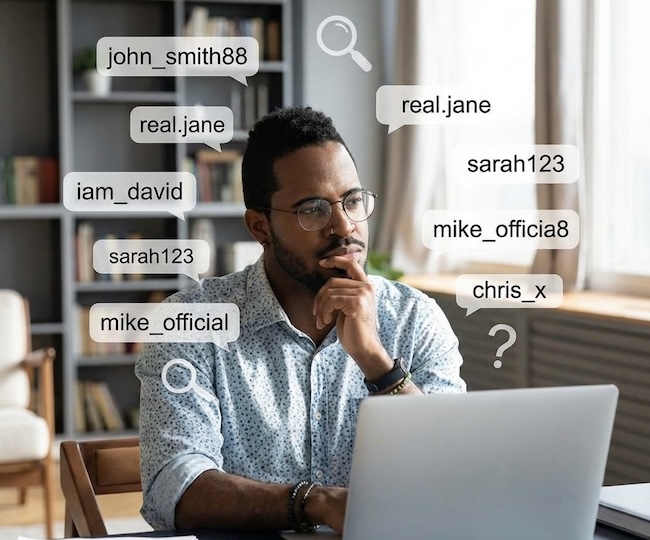
When a user signs up for Instagram, X (Twitter), or TikTok, they rarely give up if “johnsmith” is unavailable. They adapt. They add a year. They swap a letter. They add an underscore. If you understand the human psychology behind these adaptations, you can reverse-engineer their username without needing a complex software tool.
These adjustments follow patterns that you can learn and apply to uncover possible variations. This expanded guide goes deeper into username behavior, platform differences, and psychology. It pairs perfectly with tools like the Social Media Users Search, providing a more advanced manual generator checklist you can use immediately.
The Taken Problem: Why Users Change Their Handles
Every platform has its own username availability rules, and popular names are usually claimed early. Users are forced to adapt, and they do so in ways that feel natural, logical, or expressive of their identity. When the name they want is unavailable, they adjust it based on personal identity, culture, language, privacy goals, or even trends within their community.
Cultural Differences in Usernames
Naming conventions vary significantly across the globe. Understanding these can unlock usernames you would otherwise miss. (For deeper reading on how culture impacts naming, see this guide on cultural naming conventions).
- Certain cultures lean toward adding initials or shortened middle names.
- Many Spanish-speaking users combine two surnames or shorten one of them.
- German and Scandinavian users often use dots or hyphen-like separators to mimic their real surnames.
- Users in Asia sometimes add their birth year or zodiac number because it feels meaningful and easy to remember.
- Some regions incorporate nicknames that are only familiar locally, which explains uncommon spelling choices.
The Official Suffixes: Common Authenticity Additions
Public figures and creators frequently add small markers to show the audience that the account is theirs. These markers are easy guess targets when your initial search does not return results.
- _official or official_
- real placed at the start or end
- iam as a prefix, often used on Instagram and TikTok
- the at the beginning to signal status, such as thejuliacole
- hq for brands and creator teams
The Year Pattern: Numbers Users Commonly Add
Numbers are one of the most predictable clues in username variations. They rarely appear without meaning. Two major patterns dominate: birth years and current years.
- Birth years: 88, 90, 95, 2000, 2001
- Graduation years: 14, 17, 22
- Current years: 23, 24, 25, often used during signup
- Lucky numbers: 7, 8, 13, depending on culture
- Repeating digit patterns such as 111 or 999
The Underscore Logic: How People Use the Underscore
Underscores are a universal workaround when simple variations are unavailable. While they appear random, users tend to stick to a few consistent structures.
- Prefix underscore: _username
- Suffix underscore: username_
- Between names: john_doe or john__doe
- Extreme cases: name___ or ___name
- Replacing spaces in longer names
Phonetic Substitutions: Visual Tricks Users Apply
Phonetic modifications allow users to keep the sound of their name while altering the spelling. These patterns are extremely common among people who want a unique but recognizable identity across networks.
- x replacing cks or ks (alex becomes alekx or alez)
- z replacing s for stylistic impact
- k replacing a soft c
- Repeating letters for effect, like hellooo or annaaa
- Removing vowels to create a compact look, such as jhnsmth
Real Example Transformations
Below are small transformation trees showing how real users often modify their names:
- mariafernandez → maria_fernandez → maria.fdz → mari4fernandez → itsmariaf
- kevinharris → kevin_harris → kevinharris24 → realkevinh → kevinxharis
- lina → lina_ → linaz → thelina → iamlinna
- robertking → robert_king → robertking88 → robertkng → realrking
Advanced Multi Platform Behavior
Most users try to keep their identity somewhat consistent across platforms. If you discover a username variation on one platform, applying the same pattern to others usually works. For example:
- If someone uses dots on Instagram, they might switch to underscores on Twitter.
- If they shorten a surname on TikTok, they may use the full version on LinkedIn or YouTube.
- If they add a year on one platform, they often reuse that exact number everywhere else.
- If the handle includes real or official in one app, the same exists elsewhere with slight spelling changes.
The Manual Generator Checklist
Before you give up on a search, run the target’s name through this manual checklist. These 20+ variations cover the vast majority of user adaptations. Replace “name” with your target’s handle.
- name1 (The simplest addition)
- name123 (The lazy sequence)
- name (The trailing underscore)
- name (The leading underscore)
- name.official (Platform dependent)
- itsname
- iamname
- realname
- namepriv (For private or secondary accounts)
- namexo (Common in casual or younger demographics)
- namenyc (Or relevant city abbreviation)
- nameart (Or relevant hobby/profession)
- mrname / msname
- name_ (Double underscore)
- name0 (Zero instead of O)
- nameyy (Two digit birth year)
- nameyyyy (Four digit birth year)
- namedotcom (For entrepreneurs)
- thename
- nameextra (Secondary account)
Matching Usernames Across Platforms
When comparing usernames between Instagram, TikTok, Facebook, YouTube, and Twitter, look for patterns in punctuation, number placement, and prefix use. Even if the exact handle differs, the transformation logic stays consistent.
When to Stop Searching
If you have tried multiple logical variations and still find no connection, the user may intentionally use different identities across platforms. At that point, switching strategies is vital. You should move from username variations to finding social accounts by real name. Utilizing other signals such as profile photos, bios, locations, mutual contacts, or unique keywords is more effective than continuing username-only attempts.
Safety Considerations
Username search should be done responsibly. Use these strategies for verification, analysis, content research, and brand protection. Avoid actions that could invade privacy, mimic accounts, or breach platform rules. The goal is discovery, not intrusion.
This expanded approach gives you a deeper understanding of how usernames evolve and provides a practical manual generator that you can rely on whenever your initial search does not succeed.
Frequently Asked Questions
Why do people use different variations of the same username?
The main reason is availability. When a preferred handle is taken, users adjust it with numbers, underscores, or stylistic changes. Others do it to stand out, express cultural identity, or maintain privacy across platforms.
How many variations should I try before moving on?
Most usernames can be identified within 10 to 20 attempts if you are following a structured approach.
Are numbers at the end of usernames always birth years?
No. While birth years are common, numbers may also represent graduation years, lucky numbers, inside jokes, or simply the first available version the platform suggested.
Do people keep the same username across all platforms?
Many users try to maintain consistency, especially creators, professionals, and businesses. Casual users, however, may experiment with different names depending on the platform’s culture or character limits.
What suffix should I test first when a username is taken?
Start with the most common variations such as _official, real, or iam. These are widely used, especially when the person has a public profile or wants to appear trustworthy.
How can I tell if a username belongs to the same person?
Look for consistent patterns in spelling, the use of numbers, similar profile images, matching bios, repeated emojis, or links to the same websites. These clues can be stronger than the handle itself.
Is searching for username variations safe and legal?
Yes, as long as you use publicly available information and do not attempt to access private data or impersonate anyone. Stick to research, verification, and analysis within platform terms and ethical boundaries. EU GDPR privacy guidance